Executive Summary
Executive Summary
Client, a global leader in legal technology solutions, partnered with RCG to redesign its global support organization around an AI-first operating model — one that would eliminate siloed workflows, optimize resource allocation, and deliver differentiated service across customer tiers.
In just eight months, RaSee led a full structural and process transformation across Client ’s multi-product ecosystem (10+ SaaS platforms), introducing AI-driven triage, intelligent routing, and dynamic expertise pods.
The results:
- 38% improvement in SLA adherence
- 33% reduction in escalations
- 29% improvement in agent productivity
- CSAT increase from 4.1 → 4.6
- 15% reduction in cost-per-case
The program transformed Client’s support function from a product-siloed model to a unified, AI-empowered global operation — designed for scalability, speed, and customer intimacy.
Client Context and Challenge
Client delivers a suite of over 10 integrated products used by more than 15,000 legal professionals globally. As the company grew through multiple acquisitions, its support organization became fragmented across products, geographies, and tools.
Symptoms of the legacy model included:
- Siloed product teams: Each product operated its own support process, creating duplication of effort and inconsistent response quality.
- Inconsistent SLAs: Response and resolution commitments varied by team and were not aligned with customer tiering.
- High escalation volume: Lack of intelligent triage meant 25–30% of incoming tickets were misrouted or escalated prematurely.
- Limited visibility: Leadership lacked unified metrics across regions and tiers.
Client ’s leadership engaged RCG to design a future-state operating model that leveraged AI to unify support, streamline tiering, and establish a predictable, measurable service experience for every customer — from Diamond clients with 24/7 coverage to Primary-tier accounts.
Diagnostic and Root Cause Analysis
RaSee began with a comprehensive diagnostic across people, process, and technology over a 10-week period.
Key findings included:
- Reactive case handling: Support teams responded in sequence, not priority, leading to missed SLAs for high-tier customers.
- Static tiering model: Customer segmentation was defined but not enforced through case routing or escalation logic.
- Limited knowledge re-use: Less than 20% of cases used existing solutions due to inconsistent article quality and tagging.
- Siloed systems: Multiple instances of Zendesk and Jira across products prevented unified reporting and AI training.
- Role misalignment: Agents spent ~40% of time on administrative tasks (routing, summarization, or updates) that could be automated.
These gaps made it clear that Client’s growth required an AI-first structural redesign — not just automation, but a redefinition of how work moved through the organization.
RCG’s AI-Enabled Tiering Model Strategy
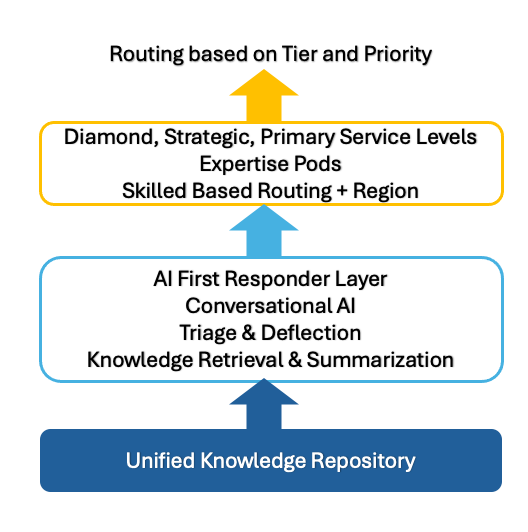
RCG developed and executed a three-layered organizational redesign, embedding AI as the first response layer and aligning human expertise dynamically by customer tier and product domain.
- AI First-Responder Layer
- Deployed Forethought Solve and Zendesk AI for automated triage, categorization, and knowledge surfacing.
- Integrated Client’s knowledge base into an AI knowledge engine, providing instant answers for Tier 0/1 issues.
- Configured AI auto-routing by customer tier, urgency, and product complexity — ensuring Diamond-tier cases bypass general queues.
- Expertise Pods & Skill Alignment
- Replaced static Tier 1/2/3 structure with dynamic expertise pods, each aligned to a family of products.
- Established AI-guided routing within pods — matching cases to agents based on skill history, SLA targets, and availability.
- Created specialist escalation roles for complex, cross-product issues to ensure knowledge continuity.
- Tiered Service Model (Diamond / Strategic / Primary)
- Defined differentiated SLA, communication, and ownership rules for each tier.
- Enabled AI-driven visibility dashboards in Zendesk to track adherence by tier, product, and region.
- Introduced proactive monitoring for Diamond accounts — AI models flagged accounts with negative sentiment or repeated issues for early outreach.
This architecture became the foundation of Client’s AI-First Tiering Framework, balancing automation with human expertise to maximize both efficiency and customer experience.
Implementation and Change Management
RCG led the rollout in four global waves, ensuring alignment across all regions and product teams:
- Wave 1 – North America Core Products: Replaced manual triage with AI routing and chatbot deflection (Zendesk + Forethought integration).
- Wave 2 – EMEA & APAC: Consolidated regional queues into unified global workflows, ensuring consistent SLA enforcement.
- Wave 3 – Multi-Product Knowledge Unification: Migrated legacy KBs into a single AI-indexed repository, applying RCG’s Knowledge Loop governance.
- Wave 4 – AI Governance & Training: Established the AI Governance Board, including RCG consultants, Client’s SVP of Support, and Product Leaders — meeting biweekly to review precision, deflection, and routing metrics.
People Enablement:
- Introduced AI Tool Owners responsible for maintaining prompt accuracy and feedback loops.
- Trained 80+ global support staff on AI-assisted workflows, knowledge authoring, and SLA accountability.
- Conducted management workshops on “AI Trust & Oversight” to drive adoption and confidence.
Outcomes and Quantified Impact
Six months post-transformation, measurable improvements were achieved across all performance dimensions:
|
Metric |
Before |
After |
Change |
|
SLA Adherence |
74% |
93% |
↑ 19 pts |
|
Escalation Rate |
29% |
19% |
↓ 33% |
|
Agent Productivity (Cases/Month) |
72 |
93 |
↑ 29% |
|
CSAT |
4.1 |
4.6 |
↑ 0.5 |
|
Cost per Case |
$21.40 |
$18.20 |
↓ 15% |
Additional qualitative outcomes:
- Unified global reporting across all product lines via AI dashboards.
- 50% faster routing accuracy for Diamond-tier clients.
- Enhanced morale and retention — agents reported greater focus on meaningful, technical work.
- Leadership gained visibility into AI model performance, enabling continuous optimization.
Lessons Learned & Best Practices
- AI requires clear role definition: Introducing “AI Tool Owner” and “Knowledge Curator” roles ensured accountability and model accuracy.
- Customer tiering must drive routing logic: Aligning SLAs, escalation paths, and response priorities to customer value was key to measurable outcomes.
- Change management is non-negotiable: Early engagement, transparent metrics, and leadership sponsorship built lasting adoption.
- Data quality drives AI performance: clean taxonomy, consistent tagging, and continuous retraining ensured high precision and trust in automation.
Conclusion
RaSee Consulting’s partnership with Client exemplifies how organizational design and AI strategy converge to deliver scalable, intelligent support. By unifying a multi-product ecosystem under a single AI-first framework, Client achieved measurable gains in efficiency, responsiveness, and customer experience — while building a future-ready support organization capable of evolving alongside its rapid product innovation.